Sacral Chakra (Svadhisthana): Flowing Yoga Practices
Second chakra · Element: water · Seed sound: Vam
Svadhisthana, the sacral chakra, is the second of the seven chakras and the theme of flow, creativity and moving with change. Explore five flowing yoga practices built around it, from fluid Hatha to a short seated meditation.

Seven centres
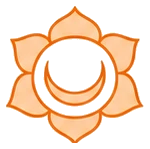
Sacral · Flowing
Svadhisthana
Creativity, pleasure, and the ability to move with change.
Sacral chakra yoga practices
Steady and fluid. Lunges, hip openers, and gentle flow, then a full rest. Good for all levels.
Heat and flow. Sun Salutations, flowing lunges, and a hip-focused peak in Goddess and Shiva Squat. Best if you’re comfortable with vinyasa.
Slow and close to the floor. Soft hip openers, easy movement, and a long rest. Good for beginners.
Long, quiet holds for the hips and lower back. Stay still and let the breath move. Good for all levels.
Ten minutes seated with the breath, water imagery, and the sound Vam. Good for all levels.
What is the sacral chakra?
The sacral chakra is the second of the seven chakras, pictured in the lower belly. Its Sanskrit name, Svadhisthana, is often translated as “one’s own place.” Traditional texts link it with water and picture it as a lotus with six petals. In modern practice, its colour is orange.
What can the sacral chakra bring to your life?
In modern chakra teaching, the sacral chakra is linked with creativity, pleasure, emotion, and ease with change — qualities that echo its element, water. Like water, it’s about letting things move rather than holding them still.
Practising with this theme won’t change your life on its own. It gives your practice a focus: a chance to notice what you enjoy, how feelings move through you, and how easily you adapt when plans change. Some days that feels like ease. Other days it shows you where you’re holding on, and that’s useful too.
How the Sacral practices explore it
Every Sacral practice moves from the hips and pelvis. Where the Root practices stand still, these ones flow: circles in Cat–Cow, lunges that rise and fall with the breath, and side-to-side movement through the hips. Hip openers make space, and a long rest lets everything settle. Choose the practice that suits your day: fluid Hatha, warm Power, restful Gentle, deep Yin, or a short seated Meditation.
Your intention: Where can I let things flow today?
The sound of the sacral: Each practice begins with the option to chant Vam (“vum”), the sacral bija mantra, softly three times — or simply listen.
Key poses for the sacral chakra
These poses appear across the Sacral practices. Each one invites movement and ease through the hips.
- Bound Angle (Baddha Konasana)
- Happy Baby (Ananda Balasana)
- Goddess (Utkata Konasana)
- Low Lunge (Anjaneyasana)
- Reverse Warrior (Viparita Virabhadrasana)
- Lizard (Utthan Pristhasana)
- Reclined Bound Angle (Supta Baddha Konasana)
Off the mat
- Make something small with no goal: a sketch, a meal, a few lines in a notebook.
- Spend a few minutes near water: a walk by the shore, a long shower, a slow cup of tea.
- When plans change, take one breath before you respond.
Questions to sit with
- What brings me simple pleasure, and when did I last make time for it?
- Where do I hold on when things change?
- How do my feelings move through me during the day?
Sources
- The Real Story on the Chakras, Christopher Wallis — a scholar’s readable history of the chakras
- A Beginner’s Guide to Chakras, Sandra Anderson — a clear introduction from Yoga International
- Svadhishthana Chakra: Pelvic Center, Sandra Anderson — a short introduction to the second chakra and its element, water
- The Serpent Power, Arthur Avalon (trans.) — the classic translation of the 16th-century text that describes the chakras
- Yoga: Effectiveness and Safety, National Center for Complementary and Integrative Health — what research says about yoga