Ask ten experienced yoga teachers how to sequence a yoga class, and you'll get ten different answers - and that's not a flaw in the system. There's no single correct sequence. What makes a sequence work has less to do with which poses you choose and more to do with the shape the class takes as a whole: whether the energy has somewhere to go.
That's the piece most guides skip. They'll tell you to warm up before you go deep, and to cool down before you finish - which is true, but it's also the easy part. The harder question is what happens in between, and how you know if it's actually working.
This guide covers both: the structural thinking that shapes any good sequence, and a way to actually see it - using the Energy Arc, a framework for visualizing how a class builds, peaks, and settles.
The 4 things that shape every sequence
Before you choose a single pose, four factors quietly decide what kind of class this is going to be:
Who you're teaching. A room of beginners and a room of experienced practitioners need different entry points into the same idea. This isn't about dumbing a sequence down - it's about choosing which poses actually deliver the intention safely for the bodies in front of you.
What the class is for. Every class benefits from a throughline - a theme, a peak pose, an intention - something the whole sequence is quietly working toward. Without one, even a technically well-ordered class can feel like a list of poses rather than a single experience.
Where and when you're teaching. A 6 a.m. class asks for a different energetic arc than an evening restorative session. Class length matters too - a 30-minute lunchtime flow and a 90-minute workshop aren't the same sequence compressed or stretched; they're different shapes entirely.
How the energy needs to move. This is the piece that ties the other three together, and it's the part most sequences get wrong - not because teachers don't think about it, but because it's hard to think about something you can't see.
The Energy Arc: making the invisible part visible
Here's the idea in plain terms: every well-built class has a shape. Energy rises, it peaks - sometimes more than once - and then it settles. Most guides describe this. Almost none show it.
That's what the Energy Arc does. It's a framework that maps a sequence across nine stages, each with a distinct energetic job:
- Arrive - settling in, connecting with breath
- Warm Up - gentle movement, preparing the body
- Activate - waking up the muscles that will be asked to work
- Build (Layer 1) - the first real layer of intensity
- Elevate (Layer 2) - energy climbing further
- Ignite (Layer 3) - the peak of the class
- Integrate - bringing the intensity back down with intention, not abruptness
- Soften - deeper release, less effort
- Rest - stillness
Laid out as a visual arc, you can see at a glance whether a sequence actually builds - or whether it plateaus, spikes too early, or ends too sharply for the body to land safely. That last one is more common than teachers realize: a class that goes hard right up until the final minute and then stops isn't cooling down, it's just ending.
Seeing the shape of a class this way turns sequencing from something you feel your way through into something you can actually evaluate before you ever step onto the mat.
Choosing a peak pose
One reliable way to build the Build → Elevate → Ignite stages of the arc is to work backward from a single peak pose - a posture the whole class is quietly preparing the body for.
Once you've picked one, break it down into the handful of physical actions it actually requires - which joints need to open, which muscles need to be warm, which movement patterns need to already feel familiar by the time you get there. Then sequence toward those component parts, not just toward "harder poses."
This is a genuinely useful method, and it's not the only one - vignette-style sequencing (grouping poses into short thematic clusters) and standing-series sequencing (building around a repeated standing sequence, like a modified sun salutation) both work well too, especially for classes without one obvious peak pose. The Energy Arc works underneath any of these - it's not a competing method, it's the shape your chosen method should produce.
A worked example
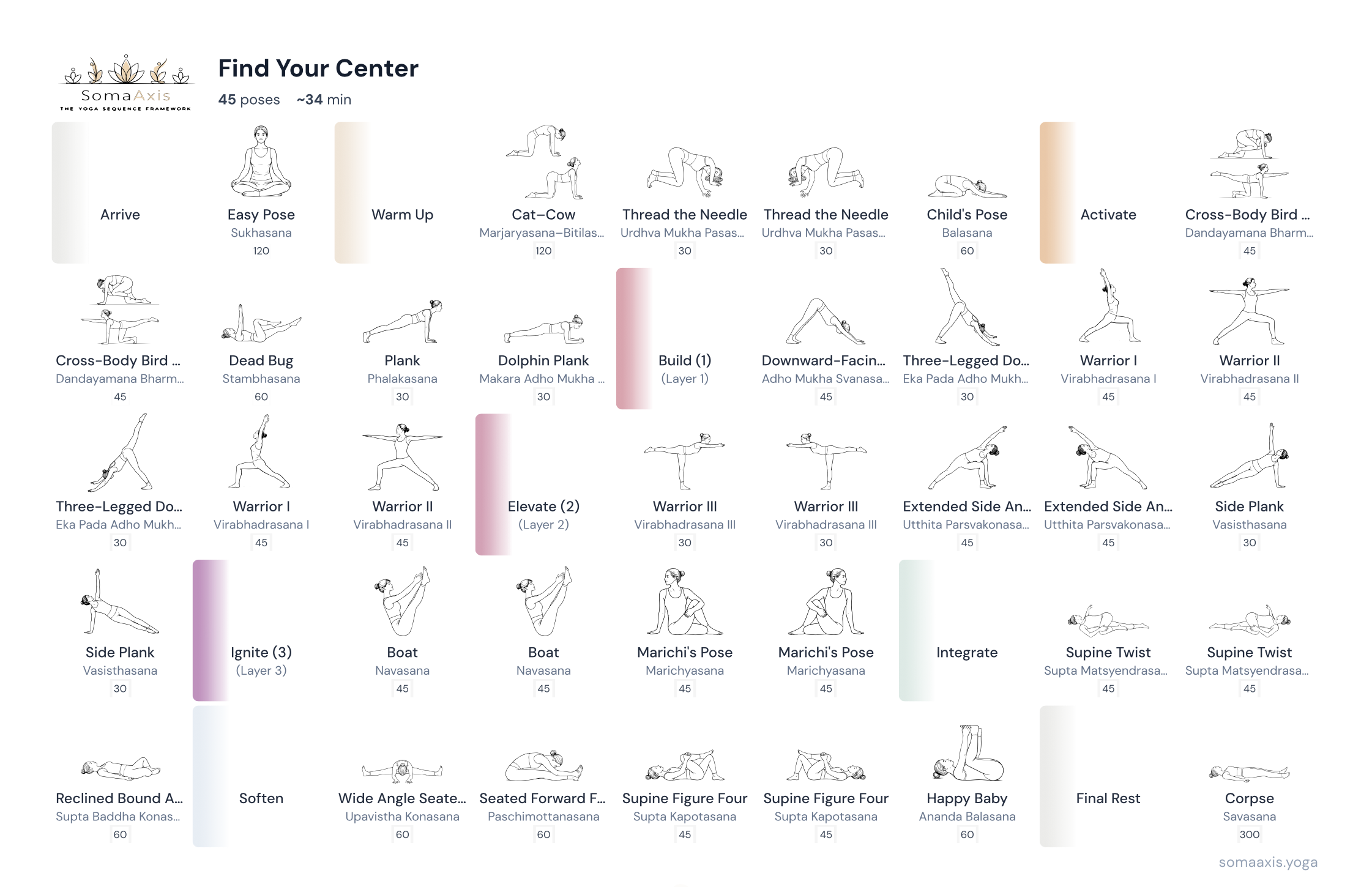
Take a sequence like Find Your Center — built around strength and stability through the midline, with rotational and stabilizing poses layered in as the class progresses. Here's the full sequence, mapped stage by stage:
| Stage | Pose | Duration | Note |
|---|---|---|---|
| Arrive | Easy Pose, breath awareness | 2 min | Settle attention on breath before any movement |
| Warm Up | Cat–Cow | 8 rounds (~2 min) | Wakes the spine before anything more demanding |
| Thread the Needle (L) | 30 sec | ||
| Thread the Needle (R) | 30 sec | Begins waking the obliques and thoracic rotation | |
| Child's Pose | 1 min | Brief reset before Activate begins | |
| Activate | Cross-Body Bird Dog Crunch (L) | 45 sec | |
| Cross-Body Bird Dog Crunch (R) | 45 sec | Core stabilizers switch on before load increases | |
| Dead Bug | 1 min | Deepens core activation while staying low-intensity | |
| Plank | 30 sec | ||
| Dolphin Plank | 30 sec | Final activation step before standing poses | |
| Build (Layer 1) | Downward-Facing Dog | 45 sec | |
| Three-Legged Down Dog (L) | 30 sec | ||
| Warrior I (L) | 45 sec | ||
| Warrior II (L) | 45 sec | ||
| Three-Legged Down Dog (R) | 30 sec | Bridges into standing work | |
| Warrior I (R) | 45 sec | ||
| Warrior II (R) | 45 sec | First real layer of standing intensity | |
| Elevate (Layer 2) | Warrior III (L) | 30 sec | |
| Warrior III (R) | 30 sec | Balance raises the demand on the core | |
| Side Plank (L) | 30 sec | ||
| Side Plank (R) | 30 sec | ||
| Extended Side Angle (L) | 45 sec | ||
| Extended Side Angle (R) | 45 sec | Builds toward rotational strength needed for the peak | |
| Ignite (Layer 3 - Peak) | Boat | 2 rounds x 45 sec | Direct core peak |
| Marichi's Pose (L) | 45 sec | ||
| Marichi's Pose (R) | 45 sec | Bound twist - the class's stated peak | |
| Integrate | Supine Twist (L) | 45 sec | |
| Supine Twist (R) | 45 sec | Begins releasing what was just engaged | |
| Reclined Bound Angle | 1 min | Passive opening, energy stepping down | |
| Soften | Wide Angle Seated Forward Bend | 1 min | |
| Seated Forward Fold | 1 min | ||
| Supine Figure Four (L) | 45 sec | ||
| Supine Figure Four (R) | 45 sec | ||
| Happy Baby | 1 min | Fully passive, no effort required | |
| Rest | Savasana | 5 min |
Total: ~34 minutes

Notice that every stage has a job. Nothing is there just because "it's usually next." That's the difference an arc-based approach makes visible — and the chart above is the actual proof, not just a description of the idea.
Common sequencing mistakes
A few patterns show up again and again in sequences that don't quite land:
No real peak. The class stays at roughly the same intensity throughout - nothing to build toward, nothing to release from.
A peak with no preparation. Jumping into a demanding pose without warming the specific joints and muscles it requires.
An abrupt ending. High intensity right up until the final pose, with no Integrate or Soften stage to bring the nervous system back down before Rest.
Repeating without reflecting. Reusing a favorite sequence indefinitely without checking whether it's still serving the class's stated intention.
Most of these are easier to catch when you can see the shape of the class laid out, rather than trying to hold the whole arc in your head while you build it pose by pose.
Reuse, don't rebuild
One of the most sustainable habits in yoga teaching is not rebuilding a sequence from scratch every week. A well-built class can be taught again - sometimes for several weeks in a row - with small intentional variations, and your students won't experience it as repetitive; a room full of different people, different energy, and a different day makes the same sequence genuinely different in practice.
The more useful skill isn't endless novelty - it's having a small set of well-built sequences you trust, that you can save, adapt, and return to. Browse sample sequences built with this framework to see it in practice.
Build your own
The Energy Arc framework above isn't just a way to think about sequencing - it's built directly into SomaAxis. As you add poses to a sequence, the Energy Arc updates in real time, so you can see the actual shape of your class as you build it, not just imagine it.
Build your own class with the SomaAxis Yoga Sequence Builder →