Plan a class, then teach it while also watching the room, cueing, adjusting, and staying present with students — all without losing track of what comes next. It's one of the quieter skills of teaching, and one almost nobody talks about openly.
So I asked. I posted the question in a yoga teachers' Facebook group: how do you keep track of your sequence while you're actually teaching? Do you rely on memory, keep something nearby, or have another way of taking "what comes next" out of your head?
The response was bigger than I expected — dozens of teachers, many with years of experience, describing exactly how they do this. A few patterns stood out.
Notes are normal — and nobody apologizes for them
If there's one thing this thread made clear, it's that experienced teachers use notes, constantly, without embarrassment. "Nothing wrong with notes" came up more than once. One teacher put it plainly: having a plan nearby doesn't mean you're not present — it shows the class you've thought it through, rather than winging it.
That reference takes a lot of forms:
- Paper and clipboards. Printed sequences on a clipboard, propped up with a phone holder, so nothing needs to be held or re-read closely.
- Physical binders. One teacher keeps every class plan as a Word document, printed and kept in a 3-ring binder, brought to every class and glanced at as needed — building, over years, a personal library of sequences she can pull from, adapt, and cut-and-paste into something new rather than starting from scratch each time.
- Small, glanceable formats. Laminated index cards small enough to fit in a palm. Hand-drawn stick figures — just enough information to recognize the next shape without stopping to read words.
- Digital references. Phone notes apps, iPads propped at the edge of the mat, even slide decks with a theme, sequence shorthand, and closing readings laid out screen by screen.
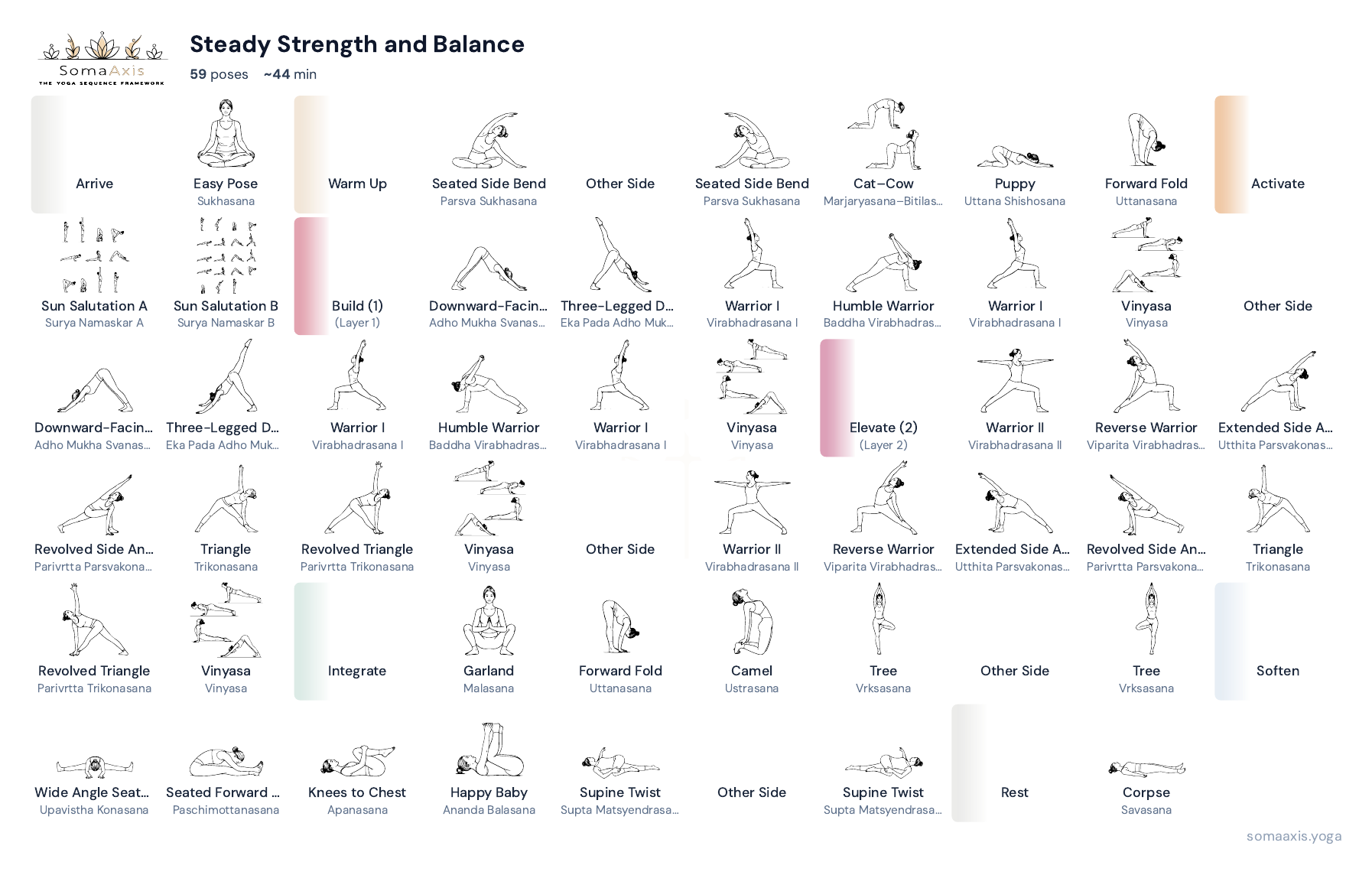
Seeing it laid out this way — one clean page, color-coded by stage, pulled straight from a sequence I'd built rather than typed and retyped by hand — is what a lot of that same instinct looks like once it doesn't have to live in a binder.
Memory works differently than people expect
Several teachers described a kind of internalized structure rather than rote memorization — breaking a class into blocks (a kneeling sequence, a standing sequence, a few "bonus" add-ons) and stringing them together in the moment, rather than holding an entire fixed sequence in mind. Once a block is practiced enough, it becomes something you can reach for without thinking, and new blocks get added at the edges as needed.
Others described organizing sequences around a peak pose, mentally grouping the class into sections by function — grounding, standing, cooldown — and just recalling what each section needs to build toward, rather than every individual pose in order.
And more than one teacher mentioned something simple but effective: demonstrating the full class themselves. Moving through it physically, rather than only thinking through it, turns out to help recall in a way that mental rehearsal alone doesn't.
The plan still bends in the room
Almost every response included some version of the same caveat: the written plan is a starting point, not a script. Teachers described changing sequences on the fly based on who actually showed up, what students requested, or how the room was moving that day. Having a plan doesn't mean following it rigidly — it means not having to hold the whole architecture of the class in your head while everything else is happening at once.
What this told me
Reading through the thread, what struck me wasn't that teachers need reminders — of course they do, teaching a full class from memory alone is a lot to ask of anyone. What struck me was how much of that reference material still lives in loose, disconnected places: a phone note here, a laminated card there, a binder of printouts built up over years, with no easy way to search, adapt, or build on it.
That's the gap SomaAxis is built for.
Unlike a printed sheet, this one moves on its own. Instead of finding your place on a static page, the current pose is simply the one showing — a quick glance tells you exactly where you are in the class without breaking your attention away from the room for more than a second. It's closer to the stick-figure shorthand teachers described, except it advances itself.
And instead of a growing pile of Word documents or a scattered notes app, My Sequences becomes that binder — a searchable library of everything you've built, ready to reuse, adapt, or pull a block from for something new.
None of this replaces the judgment teachers already bring into the room. It just means the "what comes next" question has somewhere reliable to live, so more of your attention can stay where it belongs — with your students.